
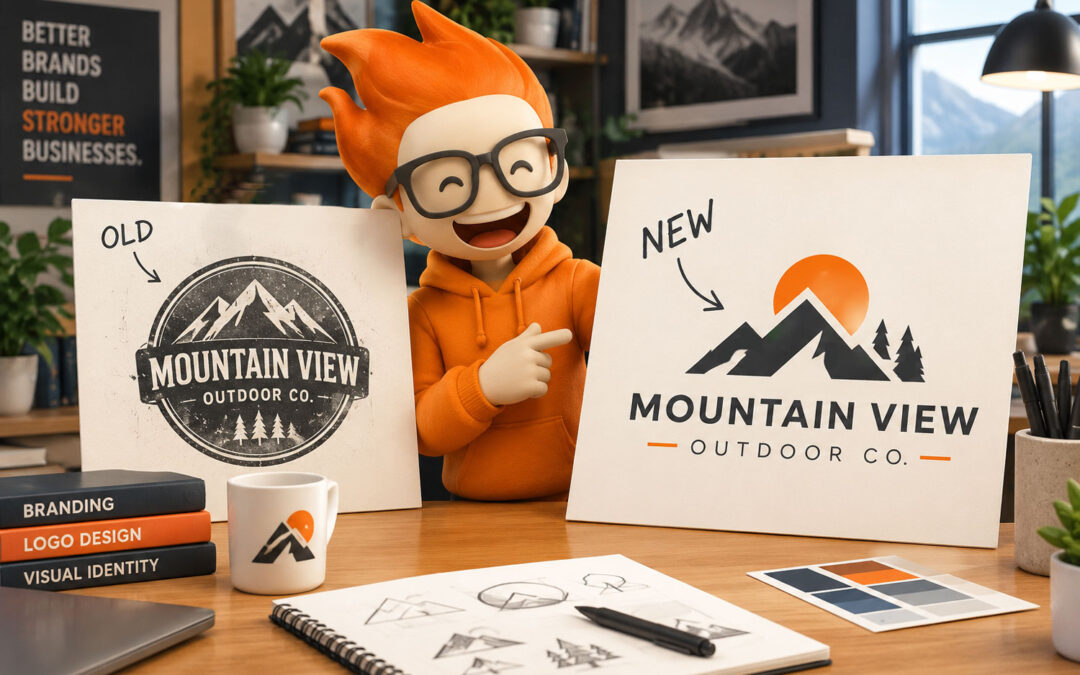
Your logo is often the first thing people notice about your business. It appears on your website, business cards, social media profiles, marketing materials, signage, and just about everywhere else your brand shows up.
When you first started your business, your logo may have been exactly what you needed. It represented your vision, helped establish your identity, and gave people something to recognize.
But businesses change. They grow, evolve, introduce new products and services, reach different audiences, and sometimes become something entirely different from what they were when they first started.
Your logo needs to keep up.
That doesn't mean every business needs a new logo every few years. In fact, some of the strongest brands have maintained a recognizable identity for decades. But there comes a point when an outdated or poorly functioning logo can hold a business back.
After years of working on branding and design projects, I've learned that recognizing when a logo needs attention isn't always as simple as deciding whether it looks old. Sometimes the real issue is that it no longer represents the business, doesn't work across modern platforms, or lacks the flexibility a growing company needs.
Here are five signs your brand may have outgrown its logo.
1. Your Logo No Longer Represents Your Business
Think about where your business started and where it is today.
Maybe you started with one service and have since expanded into several. Perhaps your original audience has changed, your company has moved into a new market, or your business has developed a more sophisticated offering.
Your logo may have been designed around the original version of your business, and that's not necessarily a bad thing. It simply means your business has evolved.
The problem occurs when your visual identity no longer reflects what customers experience when they work with you.
For example, a business that has grown from a small local operation into a professional organization serving clients nationwide may need an identity that better communicates its current capabilities. A company that has moved into premium products may need branding that reflects that positioning.
The goal isn't to make your business look bigger than it is. It's to make sure your visual identity accurately represents the business you've built.
A good logo represents who you are today, not just who you were when you started.
Before deciding to redesign, take a step back and ask yourself whether the problem is the logo itself or the broader brand strategy. Sometimes a few thoughtful adjustments are enough. Other times, a more comprehensive rebrand makes sense.
A good logo represents who you are today, not just who you were when you started.
Jordon Mazziotti
2. Your Logo Doesn't Work Well Across Digital Platforms
Logos used to be designed primarily for places like business cards, letterhead, brochures, signage, and print advertising. Those applications still matter, but today's businesses need their identities to work across a much wider range of environments.
Your logo might appear as a tiny social media profile image, in a website navigation bar, on a mobile screen, in an email signature, on a presentation, or across a large-format sign.
And each application presents different challenges.
A detailed logo that looks beautiful on a large screen might become difficult to recognize when reduced to a small icon. Thin typography may disappear at smaller sizes. A complicated symbol might lose its clarity when reproduced in a single color.
These aren't necessarily problems with the logo's age. They're problems with its versatility.
A well-designed identity should account for different sizes, backgrounds, colors, and applications. Depending on the brand, that might mean creating a primary logo, a simplified secondary version, a standalone symbol, or a compact layout for smaller spaces.
The objective is consistency without forcing the exact same logo configuration into every situation.
If you're constantly struggling to make your logo fit, or if it becomes unrecognizable whenever it's scaled down, it may be time to revisit the design.
3. Your Logo Looks Dated—and Not in a Good Way
Design trends come and go. Typography changes, color palettes shift, and visual styles that once felt modern can eventually become associated with a particular era.
There's nothing inherently wrong with an older logo. Longevity can be a strength, and a recognizable identity shouldn't be abandoned simply because a particular style is no longer trendy.
The more important question is whether your logo still communicates the right message.
Does it reflect the personality of your business? Does it appeal to the audience you're trying to reach? Does it feel consistent with the quality of your products or services?
If your logo looks noticeably out of step with the rest of your business, it may be creating a disconnect.
However, there's a difference between refreshing a logo and chasing trends.
A thoughtful logo refresh might involve refining the typography, simplifying a complicated symbol, adjusting proportions, or improving the color palette. Those changes can make an identity feel more current without throwing away the recognition you've already built.
A complete redesign is a bigger decision. It may be appropriate when the existing identity is fundamentally wrong for the business or no longer supports its direction.
The goal isn't to make your logo look newer. It's to make sure it still feels right for your brand.
The goal isn't to make your logo look newer. It's to make sure it still feels right for your brand.
Jordon Mazziotti
4. Your Branding Is Inconsistent Everywhere You Look
Here's a common situation: a company has been in business for years, and over time, different people have created different versions of its logo and marketing materials.
The website uses one logo. The business cards use another. Social media has a slightly different color palette. An old brochure features a previous version of the identity, and nobody can remember which logo file is the correct one.
Sound familiar?
This can happen gradually, especially as a business grows and different vendors, employees, or departments begin producing marketing materials.
Sometimes the solution isn't a new logo at all. It's establishing a consistent brand system.
That system should identify the correct logo files, approved color values, typography, spacing, and rules for how the identity should be used. For businesses with more complex needs, it may also include secondary logos, icons, photography guidelines, and templates.
A logo redesign can be an opportunity to establish that system, but the two things aren't interchangeable.
You can have a great logo and still have inconsistent branding. You can also have an older logo that works perfectly well when it's supported by clear guidelines and consistent applications.
The important thing is making sure your brand looks and feels like the same business wherever people encounter it.
5. Your Competitors Look More Professional Than You Do
This one can be difficult to evaluate objectively, but it's worth considering.
Take a look at the businesses competing for the same customers. How do their websites, logos, marketing materials, and overall visual identities compare with yours?
You don't need to imitate your competitors, and you certainly don't need to redesign your brand just because another company has a more fashionable logo.
But if your competitors communicate their value more clearly, present a more cohesive identity, or appear more aligned with the expectations of your target audience, it's worth asking why.
Sometimes the difference is the logo. Other times, it's the entire brand experience.
Your website may be outdated. Your photography may not reflect the quality of your work. Your marketing materials may lack consistency. Or your visual identity may simply fail to communicate what makes your business different.
A logo redesign can be part of the solution, but it shouldn't be expected to solve every branding problem on its own.
The best approach is to identify what's actually holding the brand back before investing in changes.
Does Your Business Need a Logo Refresh or a Complete Rebrand?
If you've recognized one or more of these signs, the next question is what to do about it.
Not every business needs to start from scratch. In many cases, a targeted refresh can solve the problem while preserving the recognition your logo has already established.
A logo refresh might make sense if:
- Your logo is recognizable but could use refinement.
- The typography or proportions need improvement.
- The existing design needs simplified versions for digital use.
- Your brand is fundamentally sound but could benefit from a more polished presentation.
A complete rebrand might make sense if:
- Your business has changed significantly since the logo was created.
- Your current identity no longer appeals to your intended audience.
- The existing logo has fundamental design or positioning problems.
- Your company needs a new identity to support a major change in direction.
- Your visual identity is part of a larger branding problem that needs to be addressed.
The right decision depends on your business, your audience, your goals, and the strengths of your existing identity.
Sometimes the smartest move is a subtle refinement. Sometimes it's a fresh start. And sometimes the logo is fine, but the rest of the brand needs attention.
Sometimes the smartest move is a subtle refinement.
Sometimes it's a fresh start.
Jordon Mazziotti
Before You Redesign, Ask Yourself These Questions
Before committing to a logo redesign, take some time to evaluate your current identity.
Does it represent our business today? Consider your current services, audience, positioning, and future direction.
Does it work everywhere we need it? Review the logo on your website, mobile screens, social profiles, print materials, signage, and apparel.
Is it recognizable? If customers already know your brand, consider what you might lose by making dramatic changes.
Is the problem really the logo? Look at your website, messaging, photography, and overall brand consistency before assuming the logo is the issue.
What do we want to accomplish? Define the reason for the redesign. A clear objective makes it easier to evaluate whether a proposed solution is successful.
These questions can help you distinguish between a logo that simply needs a little attention and a brand that needs a more substantial change.

Your Logo Should Grow With Your Business
Your logo is an important part of your brand, but it isn't your entire brand.
It's the starting point for a larger visual identity that communicates your personality, values, and position in the marketplace. When that identity is thoughtfully designed and consistently applied, it can help your business build recognition and communicate credibility over time.
If your business has changed significantly since your logo was created, it's worth taking a closer look at whether your visual identity still supports where you're headed.
You don't have to follow every trend or redesign your logo just to keep up with the competition. You need an identity that accurately represents your business, works across the places your audience encounters it, and gives you a solid foundation for growth.
At Mazziotti Design, I approach branding with that bigger picture in mind. The goal isn't simply to create something that looks good on a screen. It's to develop an identity that makes sense for the business and works in the real world.
Think your brand may have outgrown its logo? Let's talk about your branding project.
Sometimes a few thoughtful changes are all you need. Other times, it's the right opportunity to rethink the brand from the ground up.